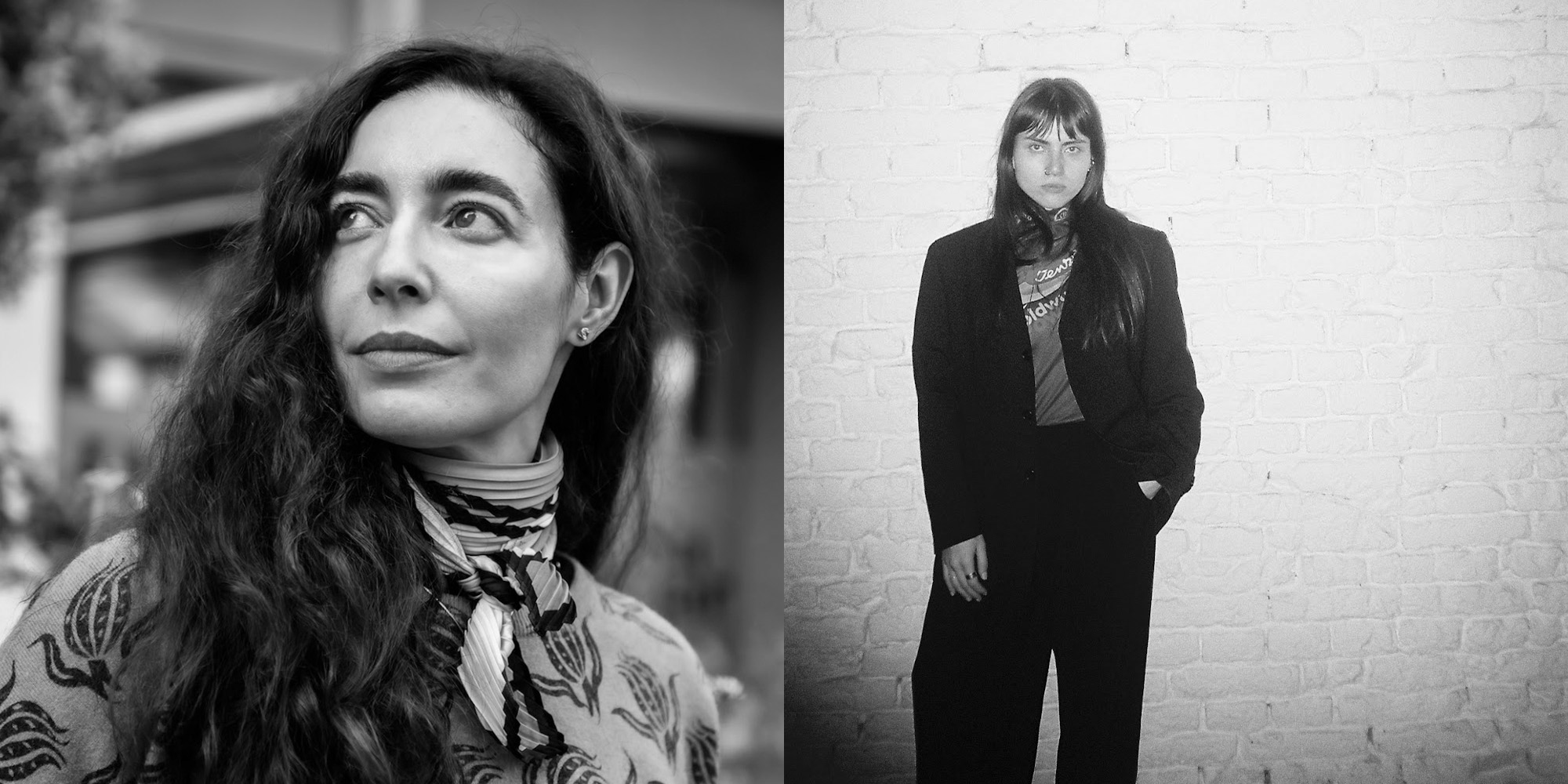
From 83 applications from all over the world, Fernanda Trías and Viktória Citráková were selected as the guests of the Writer in the Park 2027 international residency program in Ljubljana. The Ljubljana UNESCO City of Literature would like to thank all the applicants for their effort.
Fernanda Trías is an award-winning Uruguayan writer born in Montevideo, whose work has been translated into twenty languages. She is the author of five novels, two short story collections, and one collection of personal essays. Her debut novel, La azotea (The Rooftop), received an English PEN Translates Award. Her novel Mugre rosa (Pink Slime) won Uruguay’s National Literature Prize, the Bartolomé Hidalgo Critics’ Award (Uruguay), and the Sor Juana Inés de la Cruz Prize (Mexico). It was longlisted for the 2024 National Book Award for Translated Literature and named a best book of the year by NPR, Publishers Weekly, the Chicago Review of Books, and ELLE. In 2025, Trías became only the second writer to win the Sor Juana Prize twice, receiving the award for El monte de las furias (The Mountain Woman). She holds an MFA from New York University and a BA in Translation from the Universidad de la República in Uruguay.
Her current work centres on the relationship between human life and the more-than-human world, as well as on the ways in which landscapes can hold memory, violence, grief, and forms of care. In recent years, her writing has increasingly shifted from enclosed domestic spaces towards forests, mountains, and damaged environments, which she approaches not merely as settings but as active presences with agency of their own.
“The relationship between city and nature has long been one of my recurring concerns. In Pink Slime (Mugre rosa), I transformed Montevideo into a city under environmental collapse, where the river, the air, the weather, and the urban fabric become part of the same damaged ecosystem.”
As Trías explains, she has a “strong interest in the unstable boundary between city and nature, and in the ways environmental transformation alters not only landscapes but also bodies, relationships, language, and everyday life. I do not think of the natural world as something outside the city; I am interested precisely in the places where those categories reshape one another.”
She is currently working on a novel about an older woman who has devoted much of her life to reconstructing a national forest following ecological devastation. The forest becomes at once a refuge, an archive, a monument, and an impossible attempt to preserve what has been lost. “I am exploring ecological grief, memory, restoration, control, and the intimate cost of utopian ambitions: what it means to care for a future one may never inhabit, and what forms of violence can be hidden inside the desire to repair,” says Trías.
Viktória Citráková is a Slovak writer and artist based in Prague. Her work engages with autobiographical material in relation to broader socio-political contexts. Her poetry collection Synestetika (FACE, 2024) received the Ivan Krasko Prize for Best Debut in Slovakia. In 2026, she received the Audience Award at the Václav Burian Prize, which recognises Central European poetry and promotes intercultural dialogue.
She is currently developing the manuscript for her second book, a work centred on her mother and her family history, which is rooted in the region connecting eastern Slovakia and Ukraine. As Citráková explains, “The project explores intergenerational memory, migration, displacement, and the relationship between intimate family stories and broader historical and political contexts.”
Early excerpts from the manuscript were selected for COPY – Literature Board, an independent New York-based platform that presents emerging writers through curated quarterly selections. She has also recently been writing articles for KAPITÁL, an independent Slovak media platform, about war and its narratives in Central and Eastern Europe. Her articles focus on how Generation Z relates to the idea of war and how personal stories become part of broader political narratives.
Alongside her writing, she works as an independent artist and academic researcher and teaches a Feminist Literature Seminar at the Faculty of Fine Arts in Brno. Her artistic practice also encompasses video essays, video performances, exhibitions, and other curatorial projects.
In 2026, together with five colleagues working in the humanities and literature, she co-founded Odsek Books, a literary platform focused on independent publishing and community-based reading practices. The platform brings together a solidarity reading group, workshops, talks, a growing community library, and an annual book fair featuring publishers from Central and Eastern Europe, held in the cities of Brno and Prague.